



Item List
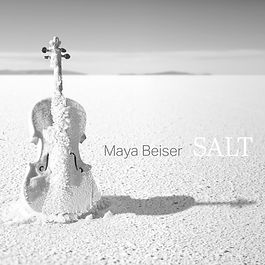
Salt: Maya Beiser
A genre-defying new album, Salt unfolds as a ritual in movement—a sonic pilgrimage through loss, memory, resistance, and return. The album begins in stillness, in the suspended breath of a woman turning to look back, and from that moment it travels across centuries and sonic landscapes, carrying fragments of Baroque hymns, sacred chants, and contemporary lamentation.
With contributions from an extraordinary roster of collaborators—composer Missy Mazzoli, librettist Erin Cressida Wilson, composer-performers Clarice Jensen and Meredith Monk, vocalist Helga Davis and Odeya Nini— Beiser reimagines works by Monteverdi, Purcell, and Gluck alongside the original compositions, creating a soundscape that feels both ancient and urgently present.
Beiser’s cello, layered into cathedral-like resonance, becomes a kind of geological instrument—textured, weathered, elemental. In Salt, beauty becomes a fulcrum—balancing the longing for what might have been against the weight of what is. Past and present collapse into one resonant cry, exposing the quiet devastation of human choices.

Maya Beiser x Terry Riley: In C
Maya Beiser‘s latest solo album reimagines Terry Riley’s epic In C as a series of ever-evolving cello loops and drones. In her multi-cello solo version, the C string – the cello’s lowest, most resonant string – forms the depth and sonic architecture of the album. Enveloped by live drumming by Shane Shanahan and Matt Kilmer, Maya creates a hypnotic, rapturous soundscape that re-envisions this classic minimalist masterpiece.
“To me,” Maya says, “Terry Riley’s In C is an amalgamation of an ‘open source’ and ‘sacred text.’ In creating this album I was interested in finding the serendipitous rhythmic and melodic connections that emerge when reconstructing In C’s 53 melodic cells as a series of cello loops, floating above continuous C string cello drones. The album explores how the mysterious world of the cello’s C string, with its rich overtones and harmonics, informs and reshapes Terry’s work in an intimate, yet expansive iteration of this classic work. This is a personal journey into a piece which was originally created and has always been performed as a communal experience.”
Terry Riley describes Maya’s performance on the recording as, “stunningly beautiful.” He says, “The overall shape flows so naturally and her cello sound is so warm and powerful.”

Maya Beiser: InfInIte Bach
"These are the Bach Cello Suites like you've never heard them before." ~ The Art Fuse magazine
"Expansive and ethereal, temporal yet spiritual.... Bach’s music receives a contemporary redux ripe with nuance." ~ Flaunt Magazine
"If anyone would give serious thought to what they had to say in recording a work like Bach’s Cello Suites, it would be Maya Beiser…"
"...Beiser’s warm, companionable tone grabs you like a family member meeting you at an airport arrivals hall, mirroring the ability of Bach’s music to point to some place specific on the map of your emotional landscape..." ~ Van Magazine
In InfInIte Bach, Maya elevates our sensory perception of the solo cello Suites of J. S. Bach in the expanded realm of spatial audio. Anchoring her body and instrument in the studio space, she reimagines this seminal Baroque work in a visceral experience that is both immersive and transcendental. The multilayered sounds of our spatial world emerge as ethereal and illuminated, like ambient lights and shadows tempering the overwhelming force of tradition.

Maya Beiser x Philip Glass
With just her cello and an array of looping and layering effects, Maya Beiser harnesses the expressive power of minimalist composer Philip Glass. She begins with works originally scored for piano, and “Etude No. 2” and “Etude No. 5,” with their simple beauty, emerge as haunting sonic sculptures, while the virtuosic, swirling “Mad Rush” is brought to urgent life with coruscating, insistent arpeggio effects. But it’s in the extracts from Glass’ soundtrack to the 2002 film Naqoyqatsi where Beiser uses her digital tools with greatest subtlety, crafting intimate, often eerie soundscapes that sit beneath a soaring, lamenting solo cello. A spellbinding journey that’s full of atmosphere.

Bowie Cello Symphonic: Blackstar
On January 8, 2016, his 69th birthday, David Bowie released “Blackstar”. He died two days later on January 10th. “Blackstar” was Bowie’s parting gift to the world, a self-eulogy, hinting at the sacred and reveling in the profane. Blackstar is a concept album, but the concept is unnamed, or is the Un-nameable itself: facing death, living in its shadow.
In this new album “Bowie Cello Symphonic: Blackstar”, visionary cellist Maya Beiser and composer/conductor Evan Ziporyn honor Bowie and his influence. Immersing themselves in this astounding music, living inside it, embodying it. Bowie’s 4-octave vocal range matches the cello almost exactly, making it the perfect protagonist instrument.
Beiser and Ziporyn re-create the entire album as a cello concerto, arranged by Ziporyn for Beiser as soloist. Accompanied by the Ambient Orchestra, Maya Beiser transforms her cello; A vocalist one moment, a lead guitarist the next, she evokes David Bowie’s spirit while never ceasing to be herself. Even in these instrumental versions, the words and their meaning hover over the music, despite their absence, much like the ‘spirit’ figure in the first song: gone, but with a trace.
Maya Beiser's latest album "Bowie Cello Symphonic: Blackstar" is now available on all major platforms and in CD and vinyl format.

delugEON
delugEON is Maya Beiser’s 12th solo album and the debut album on her newly launched label, Islandia Music Records.
Recorded during a period of 7 days in Hudson Hall, New York, delugEON breaks away from the sterile studio environment, utilizing numerous sets of microphones situated in various positions throughout the space. This concept allowed for various facets of the natural acoustics to suffuse the sound of Maya’s cello with a reverberant, ethereal voice. The entire album was recorded without the use of any artificial or digital sound manipulation.
About the concept of delugEON Maya writes:
“I have always thought of making music as an act of mining. Somewhere deep, there is a vein of music. It is the observer that makes it cohere into a certain shape. The music is discovered as it is being created. It becomes a direction.
Like many, I have been preoccupied in recent years with the impending ecological disaster unfolding in front of our eyes. I have been thinking of seasons, and water, and the accelerated extinction of helpless species. Bound to a decaying world, it is easy to become despondent and helpless. But thankfully, the music is not subjugated to the folly of man; it belongs to the universe".
The concept for delugEON began with arctic icebergs and the dark rhythms created by the sound of their near-continuous melting. As she listened to these sounds, Maya imagined the layers of her singing cello, being permeated by the sounds of a vanishing natural world. In "slow seasons" she juxtaposed multi-cello layers of each of the slow movements from Vivaldi’s "four seasons" with sounds of melting icebergs (winter), desert dunes (summer), oceanic winds (autumn) and the winds on Mars – as recorded by NASA (spring).
delugEON is music that is elegiac but not hopeless. The heart of the album is in fact the heart itself: Maya’s actual heartbeat, recorded as a pulsating drumbeat to the music of Beethoven. Maya explains: "I used a retrofitted stethoscope to record my heartbeat as I was playing the piece. when we layered my heartbeat track on top of the music, it seemed like it had always been there, hidden within Beethoven’s eternal arpeggios."
As we hear the sounds of Maya’s breathing emerging within the layers of her soaring multi-cello recreation of Olivier Messiaen’s "water", we are reminded that in ancient Greek the word psyche means “the breath of life,” and is synonymous with the soul. And we understand that this music is not a requiem for the human race in one of its darkest periods, but proof of an inextinguishable human spirit. And, if our path sometimes seems dark, don’t despair; this is music to help light the way.

The Day
" Memorable.... utterly relatable, The Day is music every bit as good as its idea."
~the Nation
"A gut punch…. nothing short of life itself: by turns hopeful, funny, surprising and tragic."
~The New York Times

TranceClassical
Maya writes, “TranceClassical started from a washed-out still photo in my mind – me, as a little girl curled with a blanket on her parents’ sofa, hearing Bach for the first time, hanging on to every mysterious note coming out of the scratchy LP. TranceClassical is the arc my mind sketches between everything I create and Bach – David Lang and Bach, Glenn Kotche and Bach, Michael Gordon and Bach. No matter how far I venture, how rebellious, or avant-garde or electronic, my artistic mooring stays with the creation of this immense genius. Was it his music? Or just being an impressionable young girl, trying to partake in her parents’ worship? Probably both. But the pieces I bring here give me a sense of trance – a reverie and meditation on his place in my heart.”

Uncovered
“Maya Beiser, the reigning queen of the avant-garde cello, has been pushing out the boundaries of her instrument for years, but in a rapturous, high-intensity performance on Saturday night at the Sixth and I Historic Synagogue, it was clear she’s now aiming at almost transcendental heights. Switching between electric and amplified acoustic cellos, using electronics to build huge and sweeping juggernauts of sound, Beiser knitted pop and overtly spiritual music together — and found a deep, almost devotional thread running through everything she played.” - The Washington Post
“She has the chops to make her cello a license-to-kill instrument …Her sense of invention borders on stupendous … Some of the songs are like tone poems, often bringing genre-defying music into modern global music consciousness.” - The Philadelphia Inquirer
“a titanic channeling of Led Zeppelin’s ‘Black Dog’ … this wasn’t anything that should be called crossover, cello-rock, or any other portmanteau genre. It was hard rock, full stop. Beiser sounds like she’s reaching deep into these songs to nd personal expression within their boundaries … Her eclecticism is borne out in her body of work, spanning multimedia performance pieces, a cello opera, and compositions written for her by Steve Reich and Philip Glass. Whether plucking out Kurt Cobain’s rhythmic intro from “Lithium” or emphatically bowing an extended solo in Jimi Hendrix’s “Little Wing” that was all drama, Beiser proved to be a fully expressive performer. She rocked convincingly one minute and teased out lyricisms another.” - The Boston Globe

Time Loops
NPR Top 10 Classical Albums Of 2012
“Maya Beiser is a gifted, TED-Talking young cellist, unafraid to push her instrument in many genre-blurring directions. On her recent album Time Loops, she conjures a chorus of cellos, looping herself electronically in a handful of fascinating compositions by Michael Harrison (with stops along the way for music by Arvo Part and Bach). Just Ancient Loops, with its evocative drone and pizzicato opening, unfolds like a journey. The music, with its blend of East and West, soars in interlocking swirls of color, rests in a central chorale and builds steam to an ecstatic conclusion, sounding as if it had always been here.”
-NPR
“The real draw to Harrison and Beiser’s new release is Just Ancient Loops… the piece is a three-movement masterpiece composed of multi-layered cello tracks. Harrison uses raga-inspired drones, minimalist rhythms and textures, and beautiful melodies to encompass us in a wonderful soundscape all inspired by ancient modes. The purity and beauty that is obtained from the cello in this piece is stunning.”
-I Care If You Listen

Provenance
“Maya Beiser has devoted her considerable gifts — a warm, gorgeous tone; a flawless technique; and above all, an intense soulfulness — to the contemporary repertory, and she is responsible for the creation of significant new works for her instrument…All of these pieces showcase the committed expressivity and unabashed emotionalism of Beiser’s playing. The works create an aura of exoticism (in the use of modes and folk instruments associated with the Near and Middle East), have a solo line that sounds freely improvisatory, and a tone that is most often passionately melancholy… The CD should be of interest to fans of virtuoso cello playing, new music, and the fusion of Western classical and world music traditions.”
-allmusic
“Using medieval Spain as a jumping off point, Beiser has commissioned a collection of works that celebrate Christian, Jewish, and Muslim musical traditions. The participants frequently interweave stylistic and ethnic boundaries. The results are frequently engaging musical hybrids… A hopeful and tantalizing glimpse at what music-making and, indeed, cultural coexistence, may increasingly look like in the future.”
-Sequenza 21
“Provenance should be listened in one sitting, from the soft intro to the long, languid, fade on the Plant/Page tune (with melodic phrases coming at the listener from all angles. Is this the sound of peace, of nations reaching across borders to interact on human levels? Maya Beiser certainly believes so – we are better for her optimism and conviction.”
-Step Tempest

Almost Human
“Stunning tour de force…hauntingly evocative and emotionally unnerving.”
-All Music Guide
“Imaginative… hip modern music from around the world… haunting atmospheric vocals, keening modal melodies from Beiser’s cello, and catchy rhythmic grooves that suggest a place exotic yet somehow familiar…. just listen with closed eyes and enjoy the journey.”
-The Boston Globe
“A thought provoking album full of charm, wit, charisma, and introverted melodies, its avant-garde lyricism paired with fantastic narration and vocals make this a truly unique and enjoyable piece of music.”
-About.com
“A sonic dreamscape that will stay with you long after the piece is over.”
“Maya Beiser is an exceptionally gifted cellist. Her musicality, technique, and commitment show in every note she plays on this fine disc.”
-Sequenza21.com